
BARC – May 2024
Welcome to the May 2024 BARC newsletter.
We hope you all enjoyed National Volunteer week 20-26 May 2024. I’d like to take the opportunity to thank you for your endless love of these pups and the commitment to our program; both temporary care and puppy raising. We are so grateful every day that we get to work with you as we prepare these wonderful dogs towards their future career pathway, whether that be a working guide, a therapy dog or a loving family pet. Regardless, we know they impact our lives in a positive way.
Current news
Canine Cough – What is it and what to do if a pup is coughing?
Canine cough is an upper respiratory infection in dogs and pups caused principally by the bacterium Bordetella bronchiseptica or the canine parainfluenza virus. There are other canine-specific viruses that can result in mild respiratory symptoms, but these are less commonly seen.
The infection is spread from dog to dog by airborne droplets created by coughing or sneezing and is highly contagious. This can be through direct contact with another infected dog, or by sharing water or toys with an infected dog.
Dogs will be contagious to other dogs prior to their symptoms showing and for up to two weeks after the cough has gone away. It can take 3-10 days after exposure for symptoms to begin.
Often the dog will cough when pressure is applied to its trachea, e.g. when it pulls against its collar, after drinking, when excited and active, and when transitioning between warm and cold air.
The cough is generally a ‘whooping’ sounding cough followed by a terminal gag.
It is unusual however, we have been seeing cases of Canine Cough in our puppy raising population (and in other dogs in the community) over the past few months: usually the Canine Cough ‘season’ is the same as the human ‘cold and flu season’, April to November.
If you hear your pup coughing:
- Check its mouth and throat for any obstruction
- Observe your pup – can it eat and drink easily? Is it lethargic? Is there any discharge from the nose or eyes; is the cough productive? If yes, what colour is the mucous?
- Call your Advisor
- Avoid contact with other dogs
For our pups, the causal microbe for Canine Cough is generally a virus (rather than the bacterial form). When vaccinated against the canine parainfluenza virus, like the human flu vaccine, the vaccine prompts the production of antibodies against a number of current strains of the virus. However, viruses change and mutate over time and sometimes the virus the pup has been exposed to is too alien for the antibodies created by the vaccine to fight. New antibodies will be created to fight the virus and the pup will get better in time but will show symptoms whilst this is happening.
Usually, our pups get better on their own without any veterinary treatment. The cough can last for a few days, but up to two weeks. However, if the cough is productive or there is discharge from the eyes or nose, or if you are not seeing a significant improvement over the first few days of illness, your pup may need to come and see the vet here at GDV. **CALL YOUR ADVISOR TO DISCUSS IF YOUR PUP NEEDS TO SEE THE VET**
If you do bring your pup to the GDV vet, please DO NOT take the pup into the vet clinic: park where the training vans are just outside the clinic and leave your pup in the car. Pop into the clinic to let the staff know you have arrived and return to your car to supervise the pup whilst you wait.
We will generally book you into a later appointment where possible so that the vet can treat other pups and dogs before seeing your pup to minimise disease spread.
Expert tips
Off lead play (written by Puppy Development Advisor, Zak)
Having worked in and managed a Doggy Daycare for nearly 5 years, I have seen all sorts of dogs mix during play and socialising and I have seen firsthand how important it is during a young dogs’ development to be exposed to positive experiences during group play.
This suitable play may be at home with your pet dog or when socialising at Guide Dogs enrichment groups.
I have a pet Labrador myself who attended daycare with me 3-4 times a week for over 3 years. Being a typical Labrador (boisterous, energetic, constantly hungry, keen to say hi to every dog and every person in sight) he mixed really well with most breeds, however he could be just way too much for others. Something I frequently saw for years was that Labradors typically play best, and enjoy playing most, with other Labradors as is the case with many breed varieties, understanding their own breed best.
Off lead play and socialising is a very important part of any pup’s development if done correctly.
There are a number of benefits to off lead play such as mental stimulation, socialising, physical health and even muscle development as it allows for more free and natural movements.
While there are many benefits of off leash play, there are also many things we need to be mindful of for our pups to get the best out of this aspect of socialising, keeping in mind these dogs are developing towards becoming working dogs.
Just like every other aspect of the puppy raising journey, we want to set our pups up for success, especially when it comes to something as exciting as off leash play.
Things to be mindful of when selecting an area for off leash play:
- Dogs in temp care are not to be let off lead (this includes working Guide Dogs or pups in temp care, they do not have established relationships with the current carer.)
- Making sure the area is securely enclosed, e.g. a private garden, enclosed oval etc.
- Only pups over 5 months of age can visit parks and ovals, as they are fully vaccinated and have basic recall training.
- Making sure that the area is not so large that the pup can get far enough away where it can’t hear you
- Checking your surroundings. Is there lots of litter, scraps, broken glass, cigarette butts etc. on the ground that could be harmful or a big distraction to the pups, if so, avoid this area.
- Are there lots of rowdy, boisterous pet dogs in the area that may be too rough, have inappropriate play, or are not friendly/willing to interact with the pups, if so, avoid the area.
- Are pet dog owners paying attention to what their dogs are doing. This is a big one to look out for at dog parks. While the pups may be friendly and wanting to say hi/play with everyone, other pet dogs might not be. Dog parks can be a hit and miss sometimes with suitability, so it is important to assess the situation before taking the pups outside. Things to keep an eye out for before entering: Are the dogs already at the park behaving appropriately? Are the owners paying attention to their dogs? Does the park seem overcrowded with too many people and dogs where the pup may become overwhelmed, stressed or unable to focus back on you when needed? Are the breeds in the area going to be comfortable around an excited Lab puppy? If you are unsure, please avoid the area.
Some examples of good and bad play:
Good play
- Relaxed, loose, floppy body.
- Taking turns with a winner and a loser if different games. This may look like one pup being on top during wrestles, then swapping roles where the other pup is now on top. It may look like carrying a toy around together or taking turns “winning” a game of tug.
- Exaggerated, loose body movements such as play bows.
- Nice balanced play where both dogs look comfortable and it’s not becoming over the top.
Bad play
- In daycare we would call it third wheeling. 2 dogs trying to play, and a 3rd is joining in with rough play which may include some neck, ear or ankle mouthing and sometimes some chasing or barking. This can be perceived as “ganging up” by some dogs and can lead to things escalating quickly. If you see the pup joining in as a 3rd wheel, call them away or put them back on lead to bring their energy back down to a suitable level before allowing them off lead again.
- One sided play. This is the opposite of what I mentioned above with pups taking turns of winning and losing. This is where one dog is dominating play and not making play enjoyable for another pup. Regardless if the pup in your care is the one showing the one-sided play or on the receiving end, break this up immediately and remove the pup in your care from this situation. This can quickly cause escalations when one dog is essentially being bullied and feels the need to stick up for themselves.
- Stiff, rigid body posture. Similar to what we may see in our pups with our engage/disengage exercise when they are stiff and really focused on something. During play if a pup is in this state, internally their energy is escalating and may present in a number of ways. This could show as a stress response, initiating boisterous, over the top and unsuitable play. If you see the pup in your care staring intently, call them away and try to break that intense stare quickly.
- Excessive barking. Some pups will bark out of excitement to initiate play, however excessive barking in another dog’s face can lead to escalations and should be stopped immediately.
Not sharing toys. If multiple pups are sharing a toy, keep an eye on any stiffening up of body postures and even side eyes from the pup carrying the toy. While games of “keeping off” are common and fun for pups, sometimes this can escalate into toy possession, where a pup deems the toy to be very high value and instead of sharing the toy, pup will now try to prevent anyone else from having this toy. If you notice this and the pup in your care does not have the toy, calmly put them on lead and remove them from the situation. If the pup in your care does have the toy, DO NOT try to snatch or forcibly take the toy away, this will reinforce to the pup that yes, this toy is valuable and worth fighting for as that is what you are now doing. Simply offer the pup a training treat (kibble) in an “exchange” and wait for them to drop the toy before taking it away. If the pup does not drop the toy in an exchange for training treat (kibble), calmly put the pup in your care on leash and remove them from the area. This is an important one to focus on if there are any toys at all involved during play, generally if 1 pup finds the toy high value, other pups could also start finding the toy high value.
PAWGUST
Registrations have now opened for PAWGUST 2024, and you can help us create a world where everyone who needs a Guide Dog, gets a Guide Dog. All you have to do is sign up, choose your distance to walk or run throughout August and get your friends and family to sponsor you. Register at pawgust.com.au. When you sign up, we would love for you to join our Guide Dogs Victoria Puppy Raisers and friends team by clicking here!
Inside Cute HQ
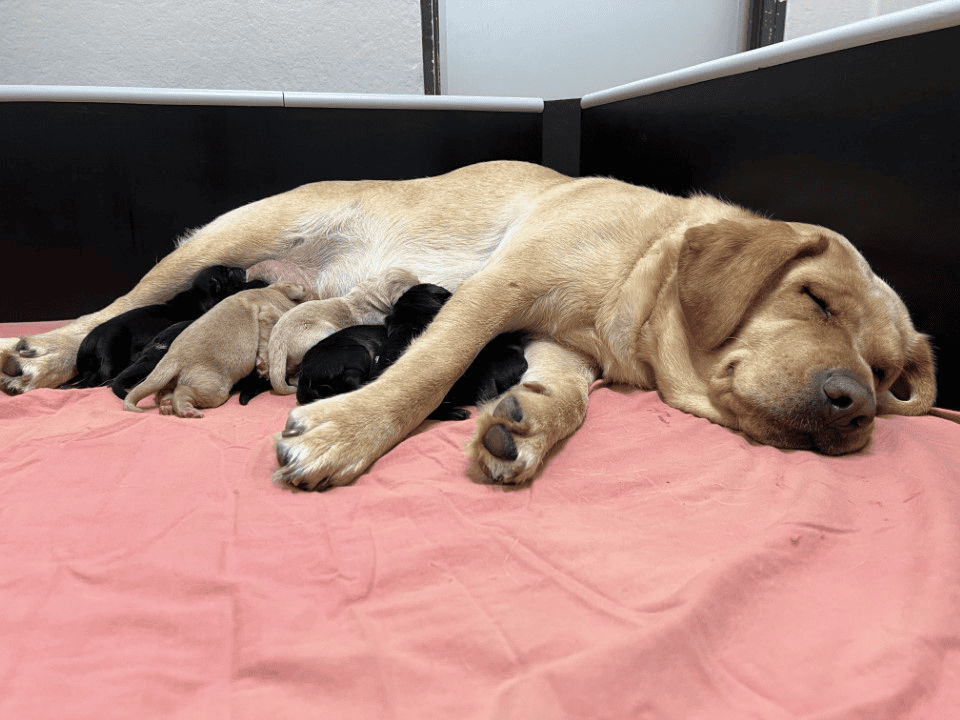
Wattle x Rudy puppies were born 04.05.24
Heading home this month:
J Litter: July, Olive (sponsored), Jensen, Juniper, Jessa, Jace, Jareth
K Litter: Kasey, Kristian, Kenya, Khoa, Karlee, Khaleesi, Cookie (sponsored), Krystal
L Litter: Luther, Ludwig, Leilah, Lex, Lotus, Lyra
For more information on the BARC Facebook Group, Enrichment Groups and Handler Workshops, please visit our Puppy Raising PAWtal with the password pawtal-24.
Thanks for all your support!
The Guide Dog Services Team at
Guide Dogs Victoria