
BARC – June 2024
Welcome to the June 2024 BARC newsletter.
The winter season has brought us cold weather, and on June 21 we experienced the shortest day and longest night of the year – also known as the winter solstice.
Hopefully all our lovely puppies had a long sleep in on the shortest day of the year!
Keep reading for tips about caring for pups over winter.
Current news
Winter safety
Keeping warm
While we rug up this winter, we should also start thinking about the comfort levels of pups in our care. If you are starting to feel cold and uncomfortable, then the pup is likely feeling the same way. Luckily, there are many simple ways you can keep pups safe and warm in winter.
As the weather gets cooler, you might notice your pup is spending more time snuggled up in their bed. You can make a few simple adjustments to their bedding to ensure they are properly protected from the cold:
- Keep pet beds away from drafts (external doors).
- Keep pet beds elevated off cold, hard surfaces like concrete.
- Add an extra blanket for warmth and comfort.
- Put cardboard between the wire of crates and their plastic trays.
- Try not to place the bed too high.
Be wary of pups sitting too close to heaters or fires as they can fall asleep, leading to dry skin or worse, burns. You may also see an increase in dandruff during winter on a black pup’s coat.
The temptation to stay inside snuggled under a blanket when it’s cold is hard to resist, but pup still needs exercise and boredom-busting stimulation. Keep playing indoors with soft toys and play the hide and seek game (speak to your Advisor if you need more info!).
Brave the cold, grab the lead, put on both your winter coats, and head out for a brisk walk together! Pup will still love the joy of their walk even if it’s a bit colder, and you will feel better for the exercise too.
It’s good for pups to be accustomed to walking in the rain, hearing the noise the traffic makes over wet roads and walking on the footpath adjacent to the road. It is good practice for the pup to become accustomed to these things initially at a distance, and then gradually build up their confidence.
Walking at dusk can be a little challenging for both Puppy Raisers and pups. Pups may find that some shapes are less recognisable when approaching and might investigate things that they’d usually pass during daylight hours without concern. Allow them to investigate items such as stumps and bins. If they show concern be sure to update your Advisor. Once you have established that they know what the odd item in the dark is, move on, and expect them to leave it next time. You must change the level of expectation once they show they are fine with that novel item or situation. Your Advisor can guide you if needed.
Safety
When walking at dusk or in the dark, please walk where streets are well lit, cross safely at pedestrian crossings if available and consider wearing reflective clothing. The pups’ coats have reflective banding on them to ensure they are visible by approaching cars. Similarly, working Guide Dogs have a reflective band on their harness. This can also be a sensible approach for your own clothing choices when walking at night.
Expert tips
Why can’t I feed my Guide Dog puppy ‘human’ food?
The job of a working Guide Dog is a unique and important one. These dogs work closely with our Clients to ensure their safety when navigating public areas, making safe street crossings, avoiding obstacles and targeting important landmarks. For added complexity, we also ask that our dogs toilet on command to ensure there are no accidents in public spaces.
This leads us to the importance of maintaining a controlled feeding routine, and providing each dog the nutritional and caloric intake they require to work as Guide Dogs, while remaining clean and at a healthy weight.
Due to the requirements specific to Guide Dog work, it is important that we refrain from supplementing a puppy’s diet with any type of human food. While carrots and other sources of fibre may be beneficial for a dog at certain times in their lives (under vet advice), providing such high-value human food can prove problematic later in a Guide Dog’s career.
Examples from real life scenarios reported by Handlers include Guide Dogs taking food from low café tables, lunging for food held in a child’s hand, constant scanning of the ground for tempting morsels during food preparation, and dogs hanging around and becoming a tripping hazard.
A dog who has never been provided high-value human food will not miss these foods and will not be looking for them in their environments.
So, the next time your puppy gives you those ‘sad eyes’ as you prepare the family meal, and you feel tempted to give in, please think of the long-term goals for this pup and help us set them up for success.
New phone system for Guide Dogs Victoria main reception
We launched a new phone menu for our ‘1800’ phone number on Monday 1 July.
The phone menu is an automated menu that allows callers to ‘self-direct’ their call to various areas of the business by pressing a respective number on their phone keypad.
Inbound callers will immediately hear a recorded general welcome.
Then you will have an option to select from the following prompts:
- Customer Service
- Donations
- Puppy Raising
- Telemarketing
Upon selecting number three for Puppy Raising, the caller will be directed to our Puppy Raising call flow. The caller will hear:
- If your call is related to an immediate health concern of the Guide Dog pup in your care, please press one (1). Your call will then be directed to the first available person, so we can best support any pup’s health emergency during business hours.
- If you would like to make a vet appointment for the Guide Dog pup in your care and it is not an emergency, please press two (2).
- For all other enquiries about Puppy Raising in general, please press three (3).
The caller can jump directly to their preferred options once familiar with the system. At any time, you may select option three to connect to Puppy Raising.
Outside of business hours continue to use VetChat as required.
Pets as Therapy wrap up
Elisha has written a wrap up for the year of Therapy Dog placements.
Pet Dog wrap up
Katrina has given me an update of the dogs who were placed at pets this year, including a little story about one particular pet dog placement of Reid.
Pet Dog classification
For those of you who have volunteered for many years as a Puppy Raiser you will be more familiar with our assessment and classification process for pups progressing through from Puppy Raising to Guide Dog training, Therapy Dog placement, Ambassador Dog program and or family pets (sale to raisers or the public).
Not every pup we breed will grow up to be a working Guide Dog, but they will, no matter where their placement is, improve the quality of life of the lucky person to be matched with them.
For many years we have called the dog who aren’t Guide Dogs, “reclassified” dogs, meaning they have been “reclassified” from their Guide Dog journey. This can happen whilst on the Puppy Raising program for health or behaviour, at the formal assessment or part way through training. Very few would make it a Guide Dog and then be “reclassified”, unless for unforeseen reasons.
It is then our responsibility as the care takers of the Guide Dog colony to ensure every dog finds the most suitable role and or home for their individual temperament and needs.
We are hoping today to put the brain trust together, like we did when naming the Facebook page and the monthly Puppy Raising newsletter, to come up with ideas for a name for our “reclassified” dog who become family pets. One assistance dog school calls them V.I.P pets.
If you have a catchy name suggestion we’d love to hear from you, please email: naomiw@guidedogsvictoria.com.au. In the coming months we will officially name our pet dog placement program and update you on the successful name suggestion from our volunteers, staff and stakeholders
Inside Cute HQ
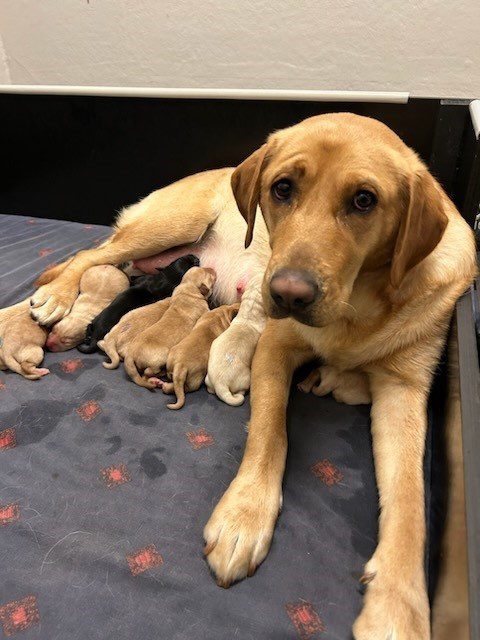
Vyka x Igor pups born 25/04/24
Heading home late this month:
M Litter: Moana, Moby, Manny, Major, Miguel, Maverick, Merl, Milo
New Dog Food Sponsorship
Guide Dogs Australia are very pleased to inform you that we have partnered with a new dog food company, Black Hawk. This partnership will see Guide Dogs Australia being supplied with dog food for our Breeding, Puppy Raising and Training Dogs.
This announcement will go public in July, until then we ask you keep this knowledge within the Guide Dog Family.
On the 16th of June we ran an information session online. If you missed this session please don’t worry, your PDA will update you with the information required to transition to the new Black Hawk diet.
This transition will take 7 days, slowly introducing the new food with a mix of the current diet. We ask you request a pickup or delivery of the Black Hawk diet when you have 1/2 to a 1/3 of a bag remaining of the current Advance diet.
We have a period of grace where our branding of Advance on our current coats is allowed. We will be rebranding the current design of coats held in stock with the new Black Hawk logo. In the coming months we will collaborate with Guide Dogs Australia to improve our current coat manufacturing.
Those pups already on speciality diets will be reviewed and in future we may trial a transition to Black Hawk.
For more information on the BARC Facebook Group, Enrichment Groups and Handler Workshops, please visit our Puppy Raising PAWtal with the password pawtal-24.
Thanks for all your support!
The Guide Dog Services Team at
Guide Dogs Victoria